- 23 November 2026
Baltic Quantum Technology Communities Agree at Vilnius University on Closer Cooperation
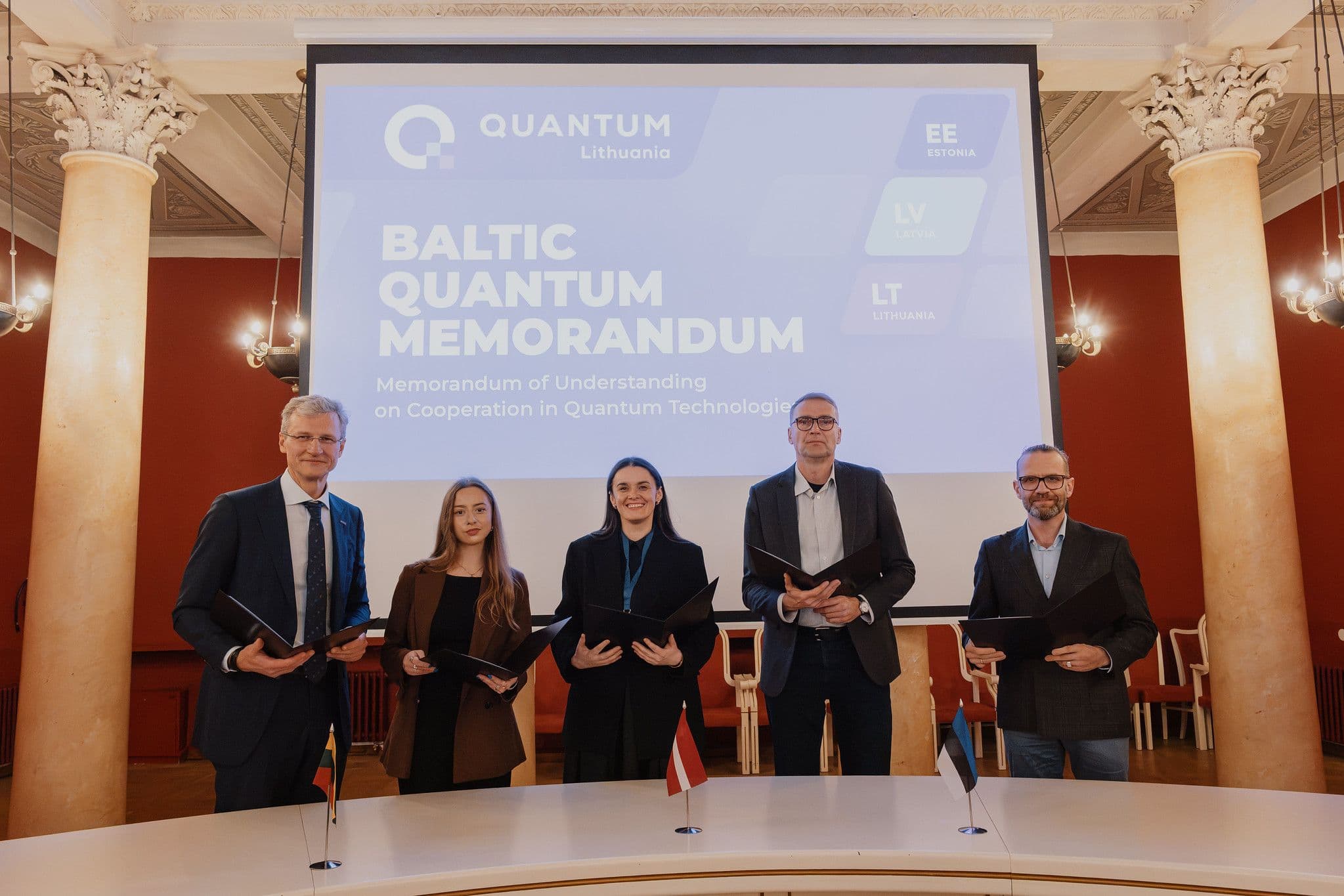
On 20 November, the Lithuanian Quantum Technologies Association ‘Quantum Lithuania’ held its annual event ‘Quantum Lithuania Annual Event 2026: Towards Baltic Cooperation’, which brought together the quantum technology communities of Lithuania, Latvia, and Estonia at Vilnius University (VU). During the event, a memorandum on cooperation in quantum technologies between Lithuania, Latvia, and Estonia was signed.
‘Through this agreement we seek to establish closer cooperation between the three countries, coordinate joint activities, events, and scientific initiatives, and strengthen the region’s quantum technology ecosystem. It is an important step towards a broader international cooperation network that could also include the Nordic countries in the future,’ said physicist Dr Mažena Mackoit-Sinkevičienė, member of the Board of the Lithuanian Quantum Technologies Association.
At the event, representatives of science, business, and the public sector discussed opportunities for joint research, international partnerships, and student exchanges. They agreed to coordinate joint activities and to speak in a more united voice in Europe.
‘Quantum technologies are attracting ever more attention worldwide because of their potential to change many fields – from information security to extremely high-performance computing power and other important areas. Quantum tools are already helping to study materials, for example in spectroscopy, and researchers are looking for the best quantum bit (qubit) platforms. Together we can become a visible and reliable partner in European quantum technology programmes,’ said VU physicist Prof. Mantas Šimėnas, member of the Board of the Lithuanian Quantum Technologies Association.
The conference programme focused extensively on the most topical issues in the quantum technology ecosystem – from the development of the field in Europe to closer cooperation between science and business to drive innovation. According to the event organisers, the Baltic states have vast potential in these areas. At VU alone, quantum technologies are studied very broadly – from research on fundamental quantum systems, quantum simulations with ultracold atoms, and quantum memory, to quantum biology, quantum computing, and lasers and photonics applications.
‘It is important for the Baltic states to pool scientific competencies, infrastructure, and funding resources so that we can jointly develop quantum technologies and their practical application. This is especially relevant now, when the European Union Quantum Act is being drafted, which will influence how investment is coordinated, industrial capacities are developed, and infrastructure is built in Europe. If we want the Baltic states to be participants rather than observers in this process, we must speak in one voice and bring specific expertise to the table. One of them is a realistic view of where quantum computing can deliver tangible benefits: in solving complex optimisation and artificial intelligence problems, for which both classical and quantum methods will be used in the near future. We need to be training specialists with expertise in both fields today,’ stressed Prof. Remigijus Paulavičius, Vice President of the Lithuanian Quantum Technologies Association and Vice-Dean for Scientific Affairs at the VU Faculty of Mathematics and Informatics.
An important part of the conference agenda was devoted to presentations of research and technologies under development. The latest progress of the European Quantum Communication Infrastructure (EuroQCI) initiative was discussed. This initiative aims to create secure, quantum-technology-based communication networks across Europe.
The keynote was given by Prof. Tommaso Calarco, Chair of the Quantum Community Network (QCN) of the European Union quantum technologies programme, the ‘Quantum Flagship’. He discussed the EU Quantum Act now being drafted and the role of the quantum technology community in shaping the future of quantum technologies in Europe. The Professor is also Secretary of the Top-Level Advisory Board on Quantum Technologies and a member of the ‘QuantERA’ Strategic Advisory Board. As one of the co-authors of the ‘European Quantum Manifesto’, the Professor has made a significant contribution to the development of quantum technologies in Europe and to shaping their strategic direction.
Miloš Soukup presented IBM’s approach to developing quantum innovation and creating such innovation hubs. Prof. Dirk Oliver Theis of the University of Tartu spoke about Estonia’s interdisciplinary quantum computing initiative.
Presentations were given by VU Professors Mantas Šimėnas, Darius Abramavičius, and Remigijus Paulavičius, Distinguished Professor Gediminas Juzeliūnas, and other researchers from VU, the Center for Physical Sciences and Technology, Kaunas University of Technology, and the Universities of Tartu and Latvia.
Representatives from the industry and associations took part in presentations on the Baltic quantum technology ecosystems. They included the Artificial Intelligence Association, the Lithuanian Laser Association, and ‘NOVIAN’.
The partners of the ‘Quantum Lithuania Annual Event 2026: Towards Baltic Cooperation’ were the Ministry of Economy and Innovation, ‘Integrated Optics’, and ‘Brolis Semiconductors’. According to the event organisers, the meeting has special significance not only for the Lithuanian quantum technology community but for the whole Baltic region.
In 2025, the International Year of Quantum Science and Technology, ‘Quantum Lithuania’ presented the Lithuanian Quantum Technology Agenda to the public. The Baltic quantum technology hackathon ‘Quantum Boost’, organised in October of the same year, brought together teams from as many as nine countries and three continents, with victories claimed by VU alumni and students.
The Lithuanian Quantum Technologies Association ‘Quantum Lithuania’ brings together scientific and business organisations working to develop quantum technologies in Lithuania and to increase international competitiveness. Since its founding in 2023, the academic community of the VU Faculty of Physics and the Faculty of Mathematics and Informatics has taken an active part in its activities.